The real reason has nothing to do with “bad news” and almost everything to do with how Bitcoin is priced today
Bitcoin has now fallen more than 53 percent in just 120 days.
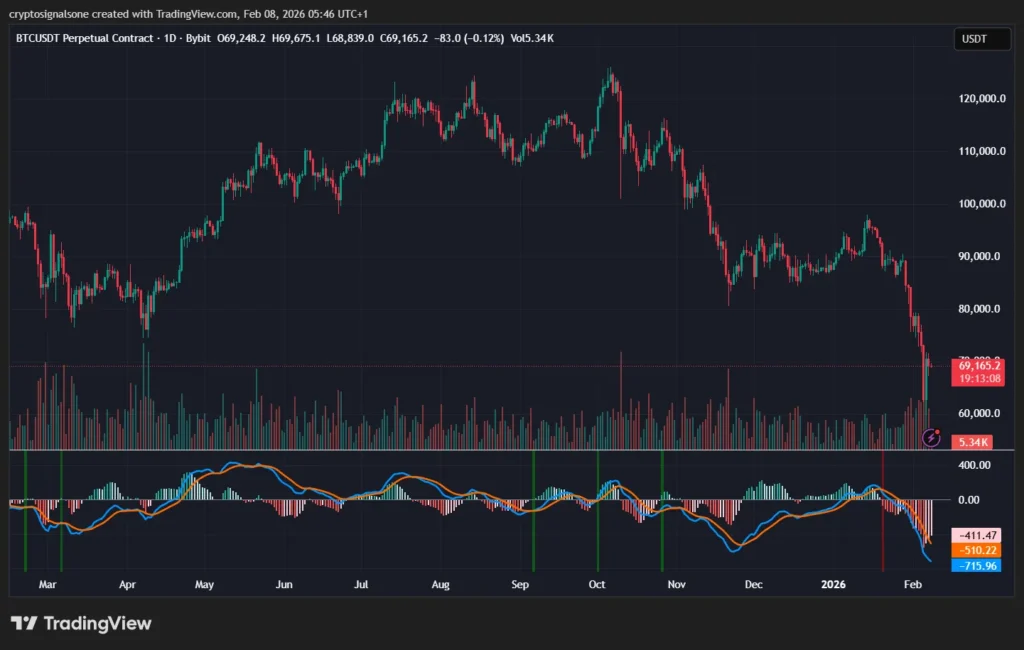
See Chart on Trading view here:
No black swan.
No major regulatory ban.
No catastrophic exchange failure.
And that’s exactly why this move matters.
Because this is not normal behavior for an asset that is supposedly driven by fixed supply and organic demand.
Macro pressure exists, yes.
But it is not the main reason Bitcoin keeps bleeding.
The real driver is deeper, structural, and still widely misunderstood.
Not a Medium member? Read the full article here.
The Broken Assumption Behind Bitcoin’s Price
Bitcoin was originally valued on a simple premise.
Fixed supply. Real buyers. Real sellers.
Price moved when people actually bought or sold coins on chain. In the early cycles, that model worked reasonably well.
Today, it no longer does.
A large portion of Bitcoin’s price discovery no longer happens in the spot market.
It happens in synthetic markets.
The Rise of Synthetic Bitcoin
Most Bitcoin exposure today does not require owning Bitcoin.
It flows through instruments like:
- Futures contracts
- Perpetual swaps
- Options markets
- ETFs
- Prime broker lending
- Wrapped BTC
- Structured products
None of these require coins to move on chain.
Yet all of them influence price.
This is the key shift most investors are still missing.
How Price Can Fall Without Spot Selling
Here’s what this means in practice.
If large players open short positions in futures, Bitcoin can drop even if no one sells spot BTC.
If leveraged longs get liquidated, forced selling occurs through derivatives, accelerating downside.
This creates liquidation cascades where positioning drives price, not real supply.
That’s why recent sell offs look so mechanical.
Long liquidation waves.
Funding flipping negative.
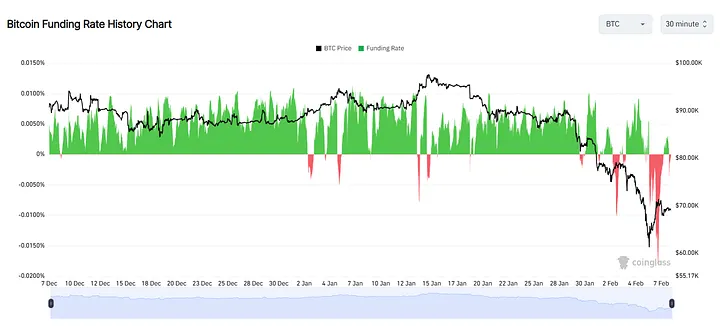
Open interest collapsing.
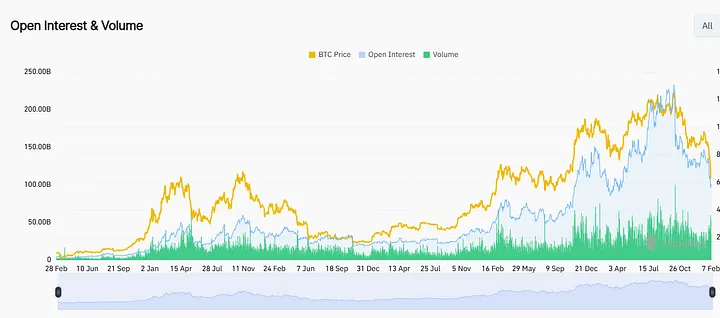
These are not emotional retail exits.
They are derivative structures unwinding.
Bitcoin’s hard cap has not changed.
But the effective tradable supply influencing price has expanded massively through synthetic exposure.
Bitcoin Now Trades Like a Leveraged Macro Asset
Price today reacts to:
- Leverage
- Hedging flows
- Institutional positioning
- Liquidity conditions
Not just spot demand.
And that brings us to the broader environment.
Global Asset Sell Off
This move is not isolated to crypto.
Equities are down.
Gold and silver are volatile.
Risk assets across markets are correcting.
When markets turn risk off, capital exits the highest risk assets first.
Crypto sits at the extreme end of that curve.
Bitcoin simply reacts faster and harder.
Macro Uncertainty and Geopolitical Risk
Rising geopolitical tensions, especially around U.S.–Iran dynamics, increase uncertainty.
Uncertainty drives defensive positioning.
Defensive positioning is not friendly to volatile assets.
When capital preservation becomes the priority, Bitcoin suffers.
Fed Liquidity Expectations Are Shifting
Markets were pricing a friendlier liquidity backdrop.
Those expectations have changed.
Even if rates eventually fall, future liquidity may stay tighter than investors assumed.
Risk assets reprice lower when liquidity expectations deteriorate.
Crypto feels it first.
Weak Economic Data Adds Pressure
Recent signals from:
- Labor markets
- Housing demand
- Credit stress
are pointing toward slowing growth.
When recession fears rise, leverage unwinds.
Crypto, being the most volatile asset class, absorbs disproportionate damage.
This Is Not Capitulation
One detail stands out.
This sell off does not look like panic.
It looks structured.
Controlled downside.
Sequential red candles.
Derivative driven liquidations.
This is not retail throwing in the towel.
This is institutional exposure being reduced.
And when institutions unwind, bounce attempts get suppressed.
Dip buyers wait.
Volatility compresses.
Price grinds lower.
Putting It All Together
Bitcoin’s decline is not about one trigger.
It’s the convergence of:
- Derivatives driven price discovery
- Synthetic supply expansion
- Global risk off flows
- Liquidity expectation shifts
- Geopolitical uncertainty
- Weak macro data
- Institutional positioning unwind
Until these pressures stabilize, relief rallies can happen.
But sustained upside becomes structurally harder.
This cycle is different.
Not because Bitcoin changed.
But because the market trading Bitcoin did.
Disclaimer: This article is for educational purposes only and should not be considered financial advice. Always conduct your own research and never trade with funds you cannot afford to lose.
This article does not contain any affiliate links. The page referenced is simply my personal page where you can enter your email if you are genuinely interested in learning more about trading.